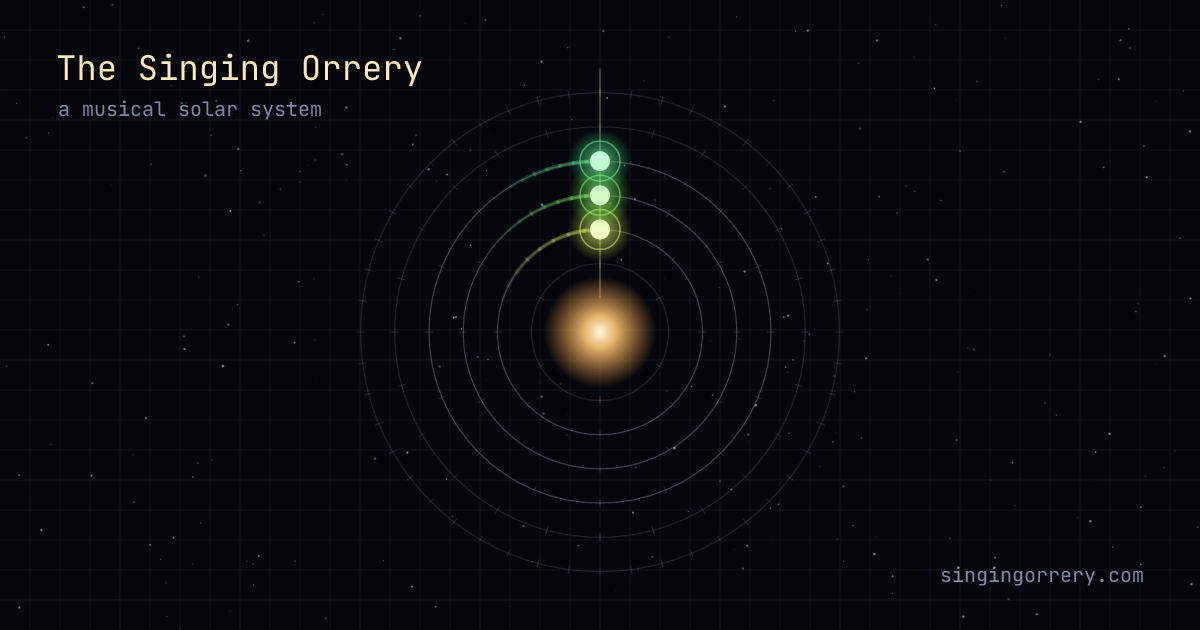
I’m genuinely excited to announce my first web toy: The Singing Orrery, a musical solar system.
👉 singingorrery.com (sound on)
I’ve written a few JavaScript games before, but this is one of the most interesting and inviting apps I’ve ever built. Perhaps it’s just the newness of it? 🤷♂️ In any case, it’s been a lot of fun creating, and I hope it’s as fun for everyone to play!
What it is
Planets circle a sun and chime as they cross the line straight above it. Tap a ring to add a planet, and tap a planet (or its tail) to take it away. That’s pretty much the rules of the game.
One neat little trick is that you can’t make it sound bad, really:
- Every ring sings one note from a pentatonic scale. That’s five notes that sound good together in any combination (the black keys on a piano make one). Inner rings sing higher.
- Every orbit fits one 12-second loop evenly. From the innermost ring out, planets go around 8, 6, 4, 3, 2 and 1 times per loop. Whatever you build comes back to where it started every 12 seconds, so every sky is a seamless little song. Astronomers call whole-number rhythms like these orbital resonances. Jupiter’s moons Io, Europa and Ganymede keep one (1 : 2 : 4).
Three ways to play
- Free play: build a sky, then share it. The link is the sky, so whoever opens it hears exactly what you made. No account, nothing saved anywhere.
- Today’s Sky: a daily puzzle. You hear a sky with its planets hidden, rebuild it, and get Wordle-style marks on each planet. Five tries. It’s the same sky for everyone, and a new one arrives at your own midnight.
- The sky on any date: pick a date from 1800 to 2050 (your birthday, maybe), and Mercury through Saturn appear where they really were that day. Then they sing.
Kepler got here first (in 1619)
In 1619, Johannes Kepler published Harmonices Mundi (The Harmony of the World), a book about the music of the planets, in which he gave each planet a voice. The same book holds what’s now called his third law: the closer a planet is to the sun, the faster it goes around. The Orrery keeps that rule. Inner rings orbit faster and sing higher.
Kepler knew six planets, and the Orrery has six rings, which is what made the date feature click: Mercury sings on the innermost ring and Saturn on the outermost.
The positions are real. The date-picked skies come from NASA JPL’s published orbital elements for the planets. We measured them against JPL’s full ephemeris (Horizons) every 10th day from 1800 to 2050, more than 9,000 dates, and the worst miss was about a fifth of a degree (Saturn). Every planet on a date’s page links to Horizons’ own answer for that date, so you can check it yourself.
You can hear a date two ways: Kepler’s song, a 12-second loop that starts from the planets’ true positions, or real speeds, where each planet moves at its true, uneven speed (about a month a second) and the date ticks forward.
Two dates worth a listen:
- July 14, 2020: all six planets bunched within about 31° of each other, the tightest since 1800.
- November 4, 2020: Jupiter catches Saturn, 0.01° apart as seen from the sun.
How it was built (for the devs)
- Nuxt 4 on Cloudflare Workers. Pages are built ahead of time or rendered at the edge, so a shared sky or a date gets its own title and preview image when you paste it into a chat.
- Canvas and the Web Audio API. Every sound is synthesized in the browser. There are no audio files at all.
- Neon (Postgres) for an anonymous daily tally of Today’s Sky results: counters only, with no user IDs, no cookies and no IP addresses.
- AI pair programming (with Claude Code). I worked as the System Co-Architect & Design Lead, Product Manager (PM), Team Lead, QA/QE, and Director, while Claude wrote most of the code, all the programmatic tests, and provided insights and feedback throughout the project.
Because my coding partner can’t hear, Claude’s Opus rendered every voice in the browser’s real audio engine and measured its loudness the way broadcasters do (ITU-R BS.1770). Then it tuned each instrument to match the bell to within a twentieth of a decibel. After that, I took a listen and said “heck yeah!”
Free, no ads, no account
Claude’s Opus kept me in check often as I learned the way of web toys. Everything you can play is free, with no ads and no sign-up. If you enjoy it, there’s an option for a one-time tip (tip jar), or a small token monthly or annual membership that adds eight more instruments: marimba, vibraphone, steelpan, gamelan, kalimba, music box, harp and glass harmonica (with more membership perks on the way).
Even the prices came from the sky.
- $2.25 a month is Venus’s year: it goes around the sun in about 225 (224.7) days.
- $18 a year is a third off twelve months ($27): 18 to 27 is a 2 to 3 ratio, which, in music, is known as a perfect fifth.
- The fifth runs all through the Orrery: its five notes are a chain of fifths (C, G, D, A, E), and two neighboring rings keep its rhythm, one going round three times while the next goes round twice in every 12-second loop.
- Kepler heard a fifth in Mars: in Harmonices Mundi (1619) he found its fastest speed round the sun close to one and a half times its slowest (1.45 by today’s numbers).
- More on the Orrery’s Support page.
A sky shared with a member instrument plays in that instrument for everyone, member or not. Here’s one on the gamelan: nine planets on all six rings. (Gamelan’s slendro scale has five notes, like the Orrery’s.) The same sky works on the marimba, steelpan or harp.
Let’s go make a musical sky

At singingorrery.com: build a sky and share a link in the comments for the community. Or alternatively, share it as part of a story or poem on StoryCore34.com.
There’s also an opt-in for occasional email updates to hear when something new lands.
Cheers!
– Keith DC | https://keithdc.com | https://storycore34.com | https://singingorrery.com
Update (October 13): You can now keep the sky on any date: a print-ready 18 × 24 inch poster and phone and desktop wallpapers, with a dedication if you like. Open any date (try your birthday) and press Keep this sky. It’s $6.87, which is Mars’s year (687 days), and is included for members.